
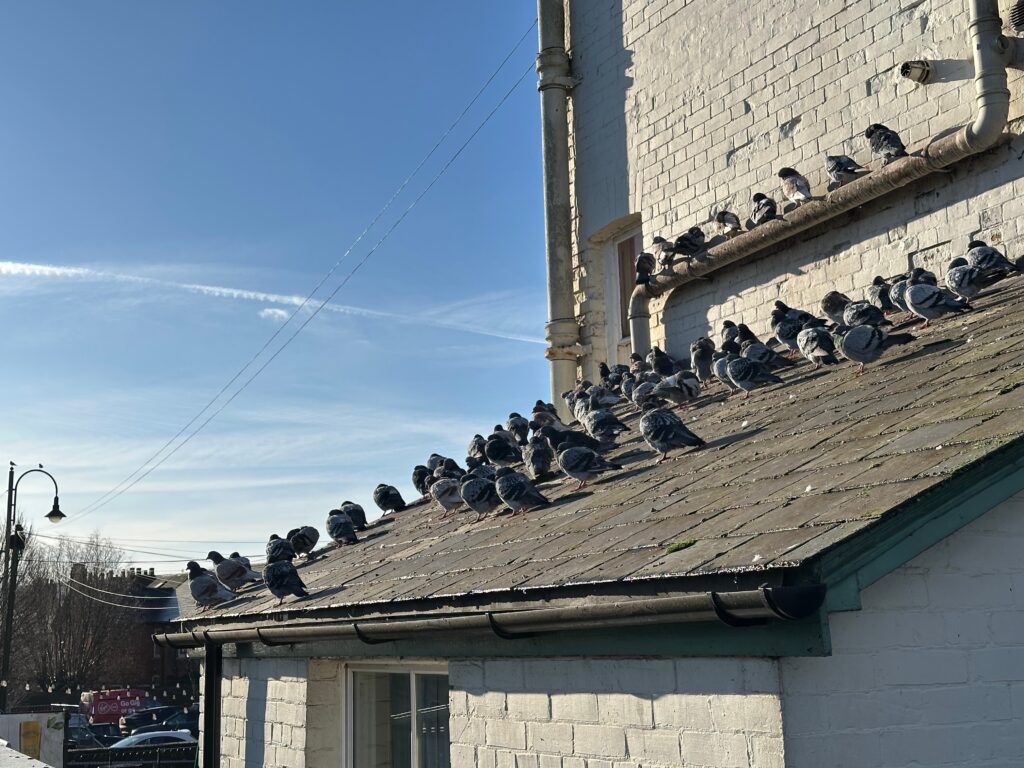
A few pigeons settling on your roof might not feel like a problem worth acting on straight away.
Then the droppings start showing up on your patio table, your car gets fouled every time you park up, and you notice nesting materials poking out from under a loose tile. What then?
By the time most homeowners call us, the birds have been there for months, sometimes years, and what looked like a minor nuisance at first has turned into a major, recurring chore with no end in sight.
This blog covers what happens when birds settle on your property, what it can cost you if you leave it too long, and the bird-proofing options that deal with it properly.
What attracts birds to your roof in the first place
Roofs offer everything a nesting bird needs: height, shelter and a clear view of anything approaching. Pigeons and gulls are drawn to ledges, chimney stacks and flat or sheltered sections of roofline because they mimic the cliff faces and crevices their wild ancestors nested on. They’re safe from ground predators, raised above the action below. Gaps under ridge tiles and broken soffits offer the same thing on a smaller scale; a dry, enclosed gap that’s awkward for anything bigger than a bird to reach.
Solar panels also make an attractive nesting spot. The space underneath them is prime real estate on a modern roof. It’s sheltered from wind and rain, and warmed by the panel above during the day. It’s a ready-made cavity that wasn’t there on older roofs, which is part of why solar installations have become such a common entry point for nesting pigeons. The more panels you’ve got, the more potential gaps there are to check.
Food plays a part, too. Gardens with bird feeders, exposed bins or even a regularly used barbecue area give birds a reason to stay close. Once they’re feeding nearby, your roof becomes the obvious place to rest and nest.
Older properties with worn pointing, loose tiles or ageing guttering are also vulnerable, because there are more gaps and ledges for birds to exploit.
None of this makes your property unusual. It’s just how most UK homes are built.
The issue isn’t that your roof is doing anything wrong. It’s that, left unchecked, it’s doing exactly what a bird is looking for.
The problems birds cause around the home
Once birds find a reliable perch or nesting spot, they don’t move on.
Pigeons, in particular, will return to the same roofline or chimney stack repeatedly, and their mess can build up fast. Droppings land on your driveway, garden furniture, washing line and parked cars. If you’ve ever tried to get dried bird mess off a car roof, you’ll know it’s not a quick wipe-down job.
The bigger issue is what bird droppings can do to your property over time. They’re acidic. Left on roof tiles, render or guttering, they’ll erode the surface.
Nesting materials block gutters and downpipes, which means water has nowhere to go except down your wall or into your roof void. That’s how a bird problem can turn into a damp problem.
Solar panels create their own problems. The gap underneath panels is warm and sheltered, which is exactly what pigeons look for when they’re nesting. Once they’re in, they can damage the wiring and reduce airflow, which can affect the efficiency of a system you’ve paid good money for.
Roof voids are similar. Birds will find their way through gaps in soffits or under loose tiles. Once they’re in your loft, you’ll have to deal with droppings, feathers and nesting debris in a space you probably don’t check that often.
There’s a health side to this, too. Bird droppings carry bacteria, fungal spores and parasites, while nests are a magnet for mites and other pests that don’t stay confined to the nest itself. And if the activity is happening above a bedroom or near a window, the scratching, flapping, persistent cooing during nesting season can become a daily disturbance rather than background noise you can tune out.
Why bird-proofing your home makes more sense than cleaning up
Cleaning up bird mess around your home doesn’t solve anything. It just resets the clock until the birds come back and do it again. Droppings left to dry are harder to remove and can be more damaging to whatever they’re sitting on. So, the longer you leave it between cleans, the worse the underlying damage gets. You’ll end up spending time and money on a problem that keeps recurring because the access point is still open.
Also, many bird species and their nests are protected under the Wildlife and Countryside Act 1981. That means you can’t simply remove an active nest or block access without knowing what you’re dealing with and when it’s legal to act.
Get the timing or the method wrong, and you could be breaking the law without meaning to. It’s one of the main reasons that bird-proofing your home isn’t a DIY job. Our team knows which species you’re dealing with, what’s permitted, and how to bird-proof the area without causing harm.
The bird-proofing options we offer to homeowners
There’s no single fix that works for every property, which is why we tailor the approach to the problems you’ve got. Here are the main bird-proofing options we offer:
- Bird netting – best suited to larger areas like courtyards, balconies or open roof voids, where you need to block access across a wide space rather than a single ledge.
- Bird spikes – a discreet, low-maintenance option for ledges, chimney stacks and roof edges. They don’t harm birds. They just remove the opportunity to land there.
- Bird wire – a near-invisible alternative for narrower ledges and architectural features, where netting or spikes would look out of place or aren’t practical to fit.
- Solar panel bird-proofing – mesh barriers or plastic skirting fitted around the underside of your panels, sealing off the nesting space without affecting how your panels perform.
- Bird-free gel – a visual and tactile deterrent for smaller, specific perching spots where a full barrier isn’t needed.
- Maintenance and repair – existing bird-proofing systems only work if they’re intact. Torn netting or loose spikes aren’t as effective. We can check and repair what you already have in place if you need us to.
We’ll survey your property first and recommend whichever combination fits what we find, rather than defaulting to the same method for every job.
Why choose MSD Pest Control?
You’ll notice an immediate and ongoing difference if you get this sorted now.
There’ll be no more scrubbing droppings off your patio or car every few days.
Your roof, render and guttering will stop taking the slow damage that droppings cause, and your solar panels will keep running at the efficiency you’ve paid for.
The health risks that come with bird droppings and nesting mites will drop away, and if noise has been an issue, your mornings will be a lot quieter.
At MSD Pest Control, we’ve helped homeowners across Derby and Derbyshire deal with the issues we’ve discussed in this blog, and we always start with a proper survey rather than guessing at a solution. You’ll get a clear, honest quote with no hidden costs, and we’ll work around your schedule rather than the other way round.
All our home bird-proofing options are humane and in line with the law, carried out by trained professionals who know what they’re doing. And if you need us back after the job’s done, we’re here.
Get in touch today to book your free survey to find out what’s causing your bird problem, and what it will take to fix it for good.